Liability that isn't capped
Indemnities that run one way, uncapped exposure on a contract worth a fraction of it, and warranties you can't actually stand behind at your size.
FOR BUSINESSES
Small businesses sign the contracts big companies wrote. Upload a supplier agreement, a service contract or a lease and Aden, Sara and Liam, the three most advanced legal AIs on the market, each with a different background and speciality, read it from your side — before you're the one holding the liability.
First contract free. No account needed, and your free upload is destroyed after analysis.
WHAT GOES WRONG
Not an exhaustive list — the recurring ones. Every finding comes back graded on the same five-step scale.
Indemnities that run one way, uncapped exposure on a contract worth a fraction of it, and warranties you can't actually stand behind at your size.
Payment windows stretched to 90 days, maintenance and repair duties shifted onto you, price-review clauses that only ever go one direction.
Auto-renewal with a notice window measured in months, termination rights that belong only to them, and exclusivity you agreed to without noticing.
WHAT YOU GET
Key Points sets your clauses beside what the market usually does and scores the deviation, so you can see where you've been pushed and by how much.
Financial Impact pulls out the clauses with money behind them and estimates what each is actually worth to you — which is usually the argument you need.
Opportunities finds the leverage you already had. The third reviewer's whole job is the trade you could offer instead of the fight you could pick.
And nothing gets past you unread: the report won't let you submit until every finding has an answer.
Review tables
Pick the documents — from one matter or from all of them — and write your questions once. Aden reads every document and answers each question in its own cell, quoting the clause the answer came from.
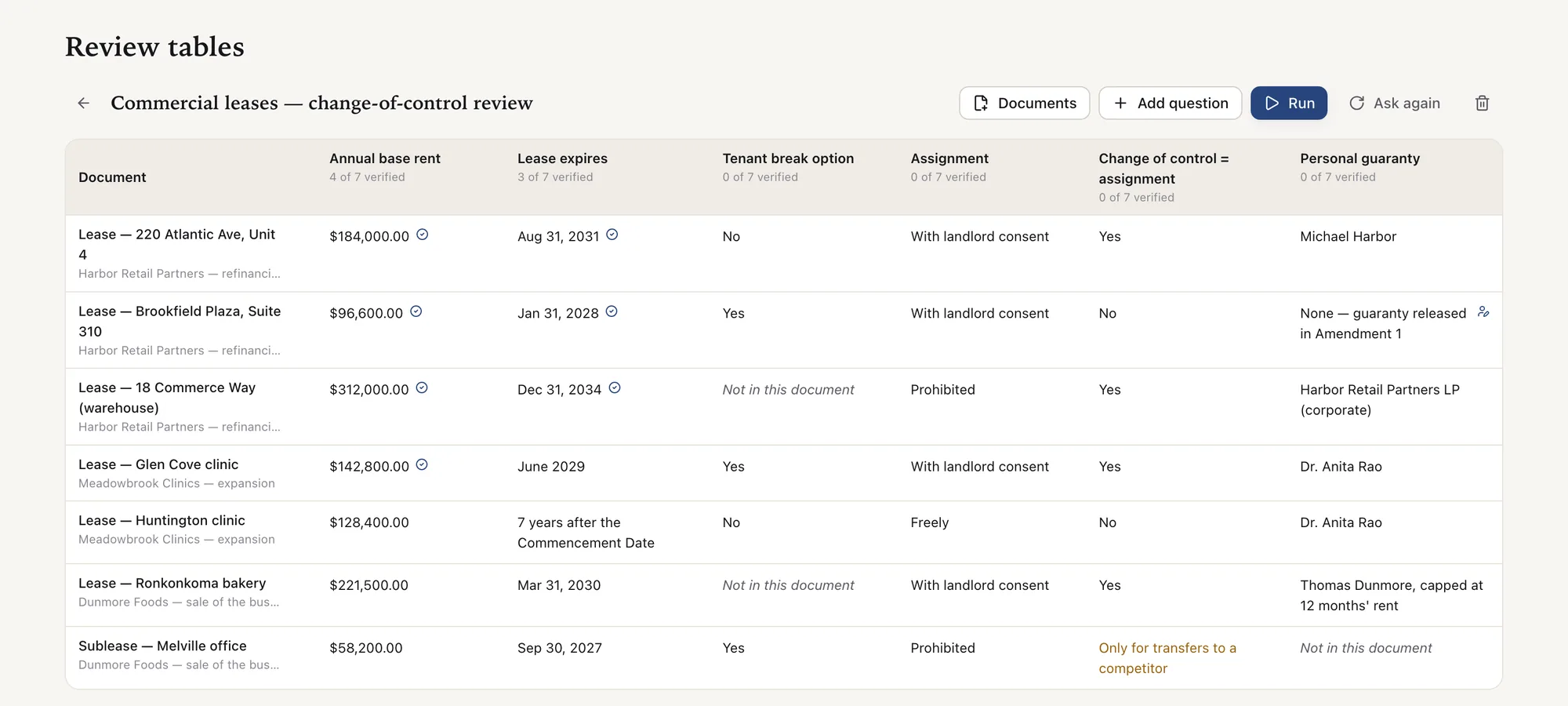
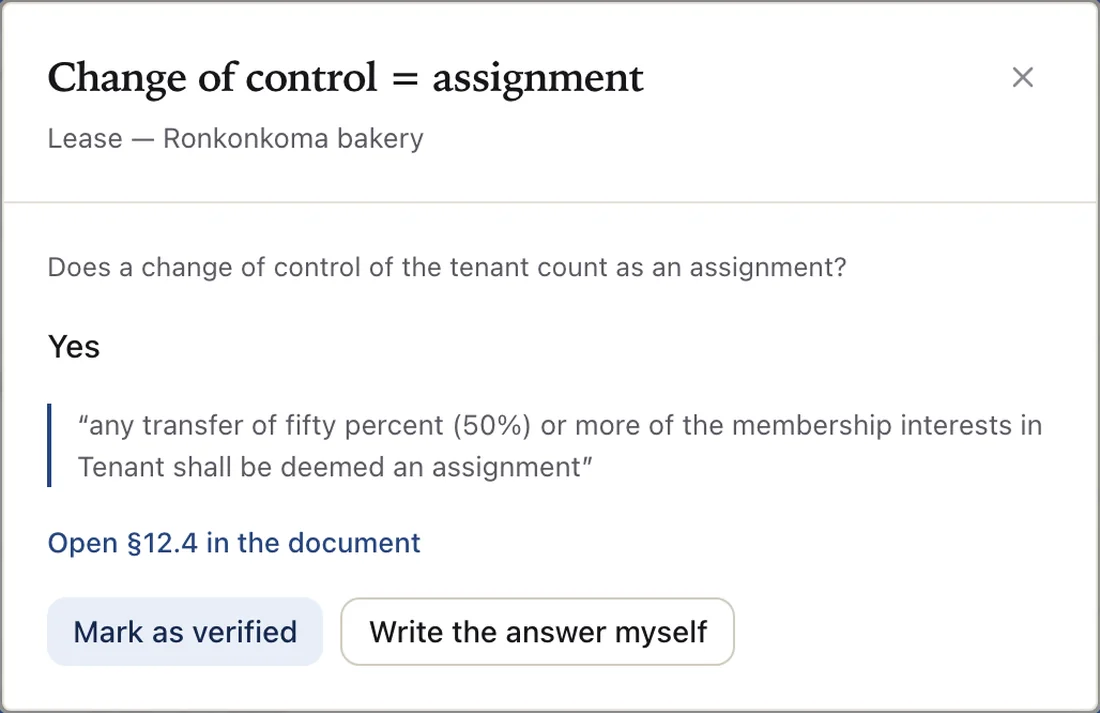
Open a cell and you see the sentence it was read from, with a link that opens the document at that clause.
“Not in this document” is a result of its own, never a blank cell — and it is often the finding. An answer that is unclear, or a file with no readable text, says so in its own words.
Mark an answer verified, or write your own. The machine's answer is kept beside yours, and each column counts how many of its answers somebody has checked.
A table belongs to the firm, not to one case — ten leases under ten clients are one table. A row from a matter you cannot see is counted, never shown.
Connections
Put the bank statements into a case and Connections draws who paid whom — read by code from every row, with no AI estimating a single number. Slide the period, or jump to the 60 days after the demand letter, and watch where the money went.
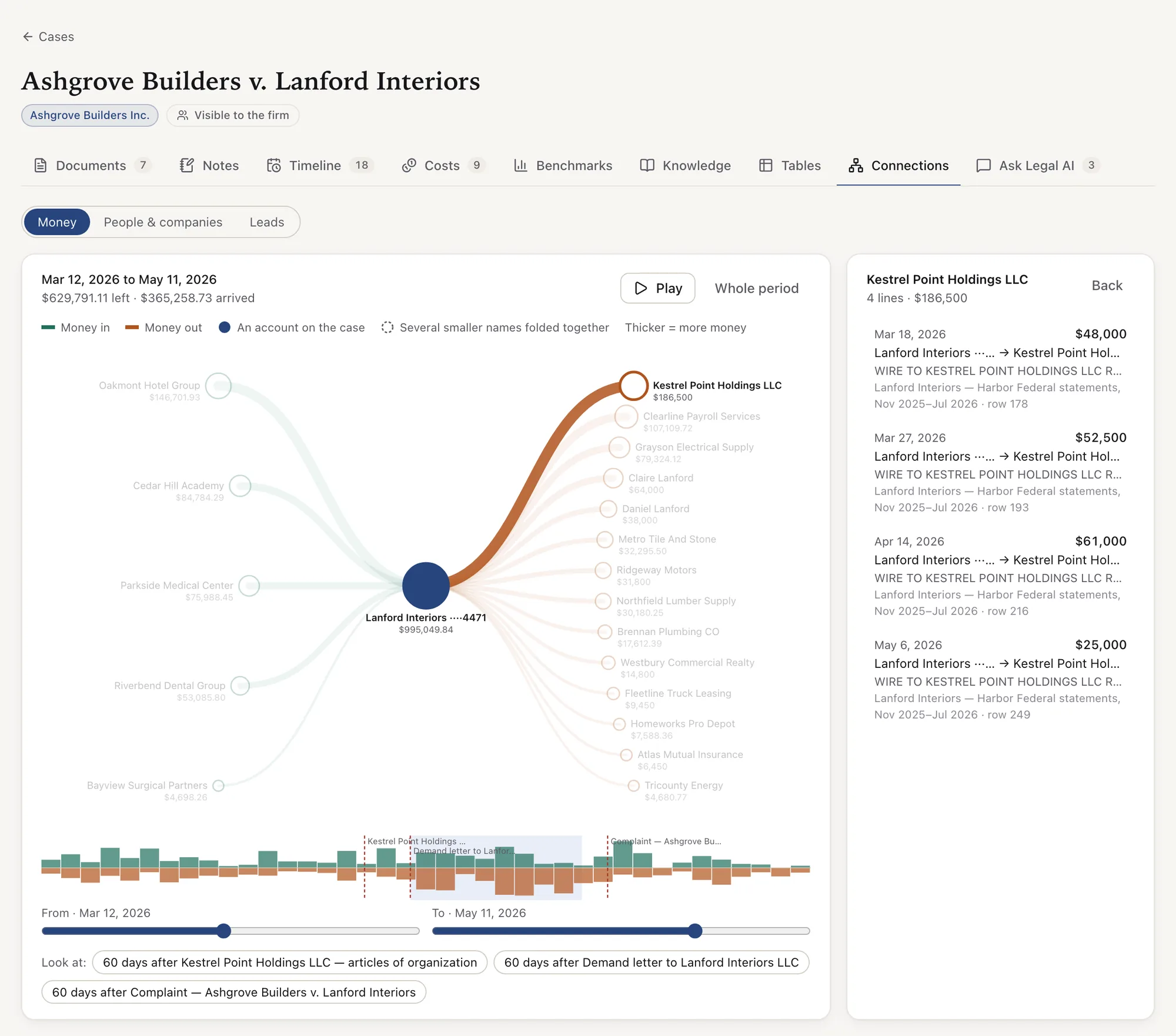
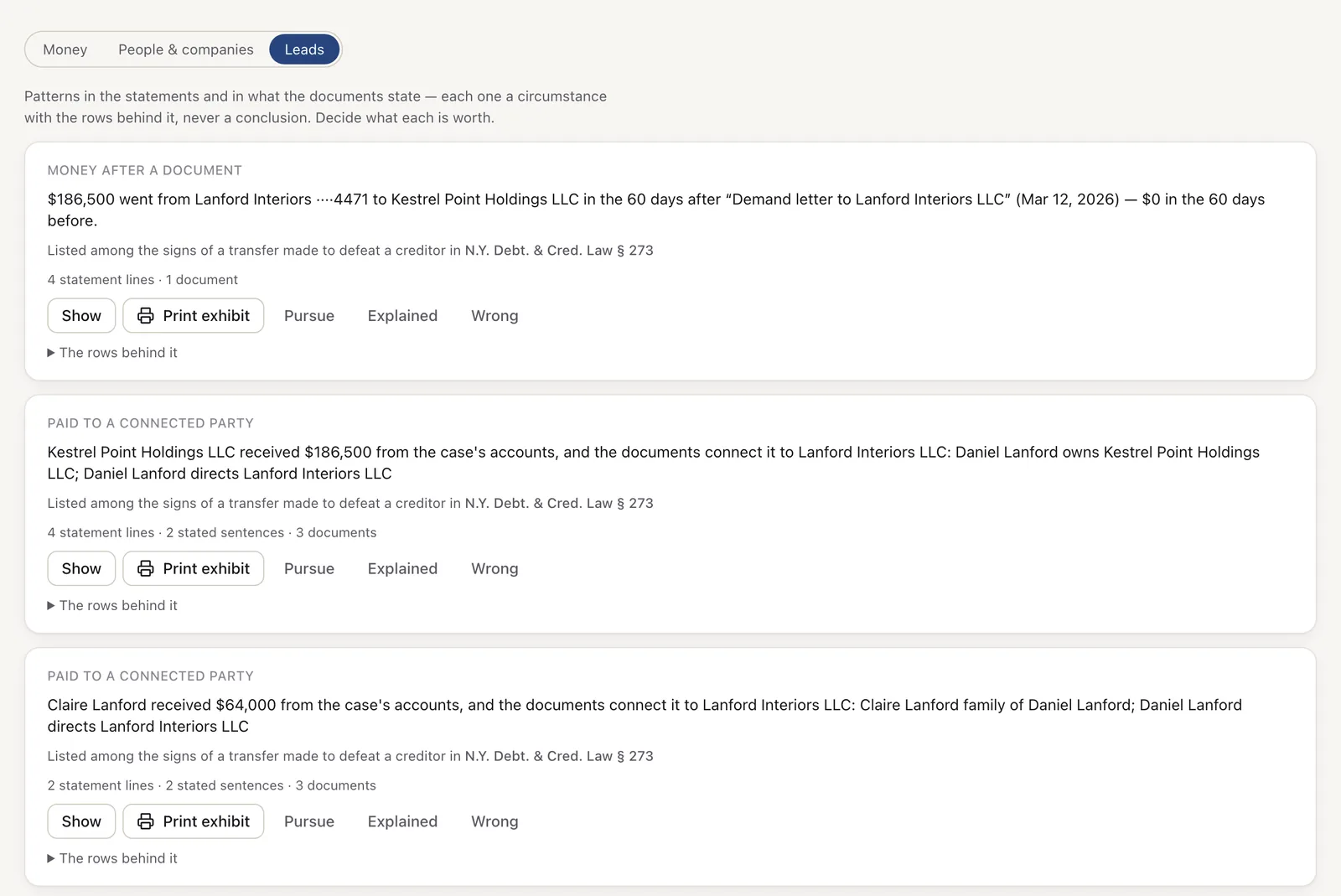
Click a payee and the rows behind the line are listed, each one opening the statement at itself. Nothing on the map is inferred.
The case's dated documents — the contract, the demand letter, the complaint — sit on the time bar, so “after the letter” is one click, and Play shows the money moving in order.
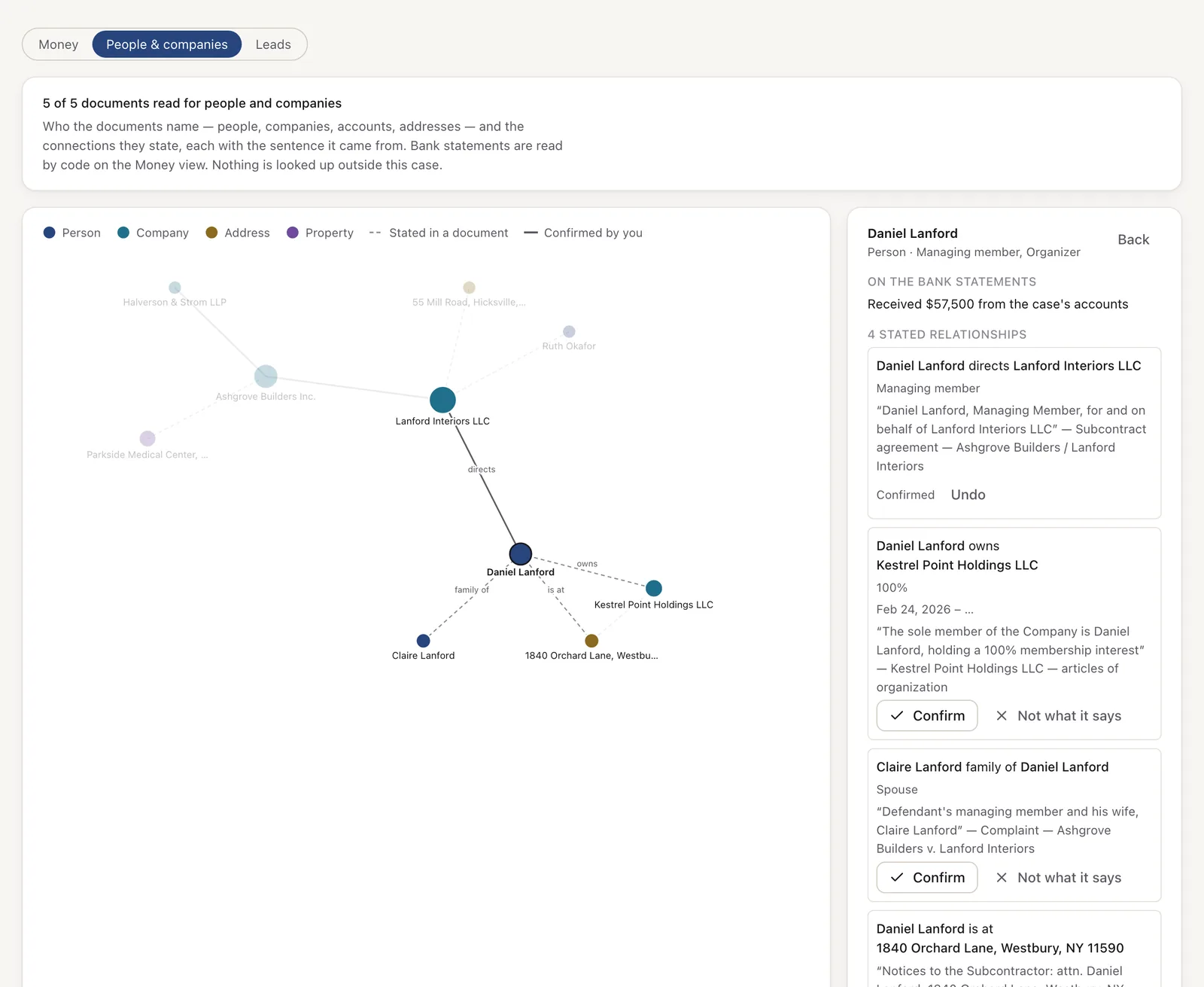
Aden reads the case's documents for who they name and how they say they are connected — who runs what, who owns what, who lives where — each link with the sentence it came from, for you to confirm.
Named checks over the money and the people: money that moved after a document, payments to a connected party, a shared address, a signature without stated authority. Each prints as an exhibit, and a statute is cited only when it was found in the actual law.
Screens from the app, on Team Pro and Team Ultimate. The matters, people and companies in them are fictional.
WORKFLOW
Meet Aden, Sara and Liam: the three most advanced legal AIs on the market, each with a different background and speciality. Every document goes round the same loop, whether the other side sent it or you asked for it to be written. The panel does the reading and the rewriting; every decision in between is yours.
Start
Upload the contract you were sent — or describe the one you need, in your own words or your own standard wording. A drafter writes it and a critic checks it from the other side of the table.
Review
Three reviewers read it: one writes the findings, two argue with them. Every finding quotes the clause it rests on.
Decide
You answer every finding before moving on: ask to change it, fine by me, not relevant, explain it, or push back with a comment.
Repeat or send
Your decisions become a new version. Send it, edit it yourself, or put it through the review again — as many rounds as it takes.
THE REPORT, IN DETAIL
Every analysis returns the same seven sections, graded on the same five-step scale, each carrying the reviewers' comments. Here is what comes back and a worked example of each.
01
The clauses that put you at risk. Uncapped liability, indemnities that run one way, warranties you can't stand behind, automatic renewals with no exit, and consent buried where nobody reads. Each red flag names the clause, states the risk in your terms, and proposes what to ask for instead.
Graded low → criticalUnlimited liability, uncapped
Your exposure isn't limited to the fees you're paid. A market position for this contract type caps it at 12 months' value.
02
Your terms, set beside what the market usually does, with a deviation score wherever yours drift. It is the difference between "this clause is unusual" and "this clause is unusual, here is the standard version, and yours is 8 out of 10 away from it" — which is the sentence that changes a negotiation.
Deviation 0–10Payment at 90 days, against a market 30
Your document: net 90 from invoice. Typical standard: net 30. That is 60 days of your working capital funding theirs.
03
What isn't in the document and should be. Absences are the hardest thing to notice when reading — there is nothing on the page to catch your eye — and they are frequently the most expensive thing about a contract. Each one comes with what its absence is likely to cost.
Graded low → criticalNo liability cap anywhere in the document
Aden flagged § 8.2; I'd add that there is no cap clause at all, not merely a weak one. That is the gap to close first.
04
The clauses with a number behind them, and an estimate of what each is worth to you. Contracts hide money in notice periods, escalation formulas, service charges and termination fees — places where the figure is never actually written down. This is where it gets written down.
Estimated exposureAnnual uplift at CPI + 3%, uncapped
Over a five-year term at recent inflation, that compounds to roughly $48,000 above a flat CPI increase on the current base.
05
Where you have leverage you didn't know about, and the specific angle for using it. This is the section that turns a list of complaints into a negotiating position — the trade you could offer, the clause worth conceding to win a better one, the ask they are likely to accept.
Graded low → criticalTrade the cap for a longer term
They want a three-year commitment. A mutual 12-month cap is a cheap concession for them and the single most valuable thing you can win here.
06
Every date, deadline, notice period, renewal window and longstop in the document, pulled into one ordered list. These are the findings that hurt most, because missing one converts a right you paid for into nothing at all, silently and without a reminder.
Dated obligationsAuto-renews unless cancelled 90 days out
Renewal date 31 March. Your notice window therefore closes 31 December — before most teams start reviewing next year's contracts.
07
How hard the document is to read, scored out of ten, with the specific sentences making it harder than it needs to be. Unreadability is not a neutral property of legal drafting: a clause nobody can parse is a clause nobody argues with.
Scored 0–10One 94-word sentence with four nested conditions
Section 6.2 defines "Permitted Use" across four dependent clauses. Rewriting it as three sentences changes nothing legally and makes § 9 arguable.
VERIFIED, NOT REMEMBERED
A language model asked for a citation returns a plausible one — sometimes real, sometimes not, and it will not tell you which. Every citation and every regulatory precedent this product shows you has been looked up first.
1,840,980
sections of U.S. state and federal law
Every state's code but two — Georgia and North Carolina hold their own copyright over theirs — plus the U.S. Code, D.C. and Puerto Rico, refreshed every quarter. The same rule: a citation we cannot verify stays plain text, never a link.
82,099
provisions of Italian law, kept in force
The Codice civile, the Codice del Consumo and Italy's legislative decrees, refreshed from Normattiva. Every statute a review names is checked against this text before it is shown as a link — one we cannot verify is left as plain words instead.
45
EU laws — GDPR and more — in Italian, English and Spanish
1,650 articles from the acts an Italian or Spanish contract leans on most — the GDPR, the unfair-terms directive, consumer rights, Rome I — read in the current, amended text, never a repealed one, and in the reader's own language.
85
rulings by Italy's competition authority since 2013
432 clauses the Autorità Garante della Concorrenza e del Mercato has already found unfair, or cleared. When a finding is about a clause of the same kind, we show you the ruling — quoted, dated and linked.
All four are checked against their source every time, never assumed. A citation that looks verified and isn't is worse than one we never made — it's the difference between telling a client what the law says and just hoping it does.
THE CATALOGUE
Not an exhaustive list of what it can read — it will analyze most commercial agreements — but these are the ones people bring most often.
Goods and services agreements between businesses or with consumers, including one-off purchases and framework supply terms.
Watches for: delivery and acceptance risk, title and risk transfer, warranty scope, limitation of liability
Employment offers, contractor agreements and consulting terms, from either side of the table.
Watches for: IP assignment reach, non-competes, notice and probation, termination and garden leave
Mutual and one-way non-disclosure agreements, including the ones stapled to a term sheet.
Watches for: definition of confidential information, term length, residuals clauses, permitted disclosures
Commercial and residential leases, licences to occupy, and short-term rental agreements.
Watches for: service charge caps, repair standard, break conditions, rent review mechanics, guarantees
Shareholder agreements, partnership deeds, founder agreements and joint venture terms.
Watches for: drag and tag rights, reserved matters, deadlock, vesting and leaver provisions
Separation, divorce and custody documents, and the financial agreements attached to them.
Watches for: asset and pension division, maintenance terms, review triggers, finality and disclosure
Purchasing, procurement, distribution and reseller agreements on either side.
Watches for: payment terms, exclusivity, minimum commitments, price review, termination for convenience
SLAs and support schedules, usually attached to a larger services contract.
Watches for: how uptime is measured, exclusions, service credits as sole remedy, escalation paths
Franchise agreements, trademark and software licences, and reseller arrangements.
Watches for: territory and exclusivity, fee structure, quality control obligations, renewal and transfer
Loan agreements, facility letters, guarantees, and equipment or invoice finance.
Watches for: true cost of borrowing, covenants, events of default, security and personal guarantees
Master service agreements, corporate services contracts and intra-group arrangements.
Watches for: order-of-precedence between documents, change control, audit rights, assignment on sale
Website and platform terms, subscription agreements and end-user licences.
Watches for: unilateral change rights, data and content licences, auto-renewal, liability exclusions
…and most other commercial agreements.
Prices include VAT and sales tax where they apply — what you see is what you pay.
Priced per seat, but the credits and the case library belong to the workspace: five seats on Team is 5,000 credits the whole firm draws on, not 1,000 stranded on each person.
A small firm where more than one person reads the contracts.
$49/ user / month $490/ user / year
1,000 credits per seat, pooled
30 active cases · 500 documents
14 days free · card required · cancel anytime before it ends
A practice with contracts arriving faster than anyone can read them.
$99/ user / month $990/ user / year
2,500 credits per seat, pooled
100 active cases · 1,000 documents
14 days free · card required · cancel anytime before it ends
Firms with their own compliance obligations to answer for.
$199/ user / month $1,990/ user / year
6,000 credits per seat, pooled
Unlimited cases and documents
14 days free · card required · cancel anytime before it ends
A business starts where everybody starts: one contract read and graded, free, with no account. Analyze a contract free
Credits are what an analysis is charged in, and the charge is the real cost of the work. Nothing is capped and no document is turned away for being long — a longer contract simply costs more to read than a short one, and a panel of three costs more than a single reviewer.
Payments are handled by Stripe. Cancel any time. Every document in a case library is encrypted at rest. The refund policy is in the terms.
QUESTIONS
The first document is free — no card and no account. After that a company buys seats: Team is $49 per user a month with 1,000 credits per seat, and the credits and the case library belong to the workspace rather than to the person, so five seats is 5,000 credits the whole company draws on instead of 1,000 stranded on each desk. Credits are charged at what the analysis actually costs to run, so a short contract costs less than a long one and a quick read costs less than the full three-lawyer panel, and there is no page limit. If it is only ever you reading the contracts, the personal plans start at $4.99 a month and run exactly the same analysis.
Supplier and vendor agreements, service contracts and SLAs, commercial leases, partnership and shareholder agreements, employment and contractor terms, and terms of service or master service agreements. PDF, Word, HTML and plain text are read directly; scans and photographs go to a vision model, on every plan.
It is aimed at exactly the gap small businesses live in — contracts too important to sign unread, too routine to justify a lawyer every time. It gives you a graded list of what is risky, what is missing and what it costs, so you can decide which contracts actually need a lawyer and arrive at that conversation already knowing the questions.
Uncapped liability, one-sided indemnities, payment terms stretched well beyond what was discussed, auto-renewal with a notice window that has already closed, and maintenance or compliance duties shifted quietly onto the smaller party. All five are things the analysis looks for by default.
Upload the contract, say which party you are, and get a graded list of everything that matters in it.
First contract free · No account required · Not legal advice